Tool Manufacturing

The Importance of Accurate Machining Drawings in Precision Engineering

In precision engineering, success is determined long before a component reaches the machine floor. Every accurate cut, tolerance, and surface finish begins with a clear and well-prepared machining drawing. These drawings serve as the primary communication tool between design engineers, machinists, and quality inspectors, ensuring that complex components are manufactured exactly as intended. When drawings are accurate, production flows smoothly; when they are not, costly errors and delays quickly follow.

Accurate machining drawings are not simply technical documents—they are the foundation of efficient, high-quality manufacturing.

CNC Projects

Clear Communication Across Teams

Precision engineering involves multiple stakeholders, from designers and engineers to machinists and quality control teams. Machining drawings provide a universal language that aligns everyone involved in the production process. They communicate dimensions, tolerances, materials, finishes, and machining notes in a format that leaves little room for interpretation.

When drawings are clear and accurate, machinists can confidently set up equipment and execute operations without repeated clarification. This clarity reduces misunderstandings, shortens lead times, and improves cross-functional collaboration.

Ensuring Dimensional Accuracy and Tight Tolerances

Precision engineering often requires components to meet extremely tight tolerances. Even minor deviations can cause assembly issues, performance failures, or premature wear. Accurate machining drawings define allowable variations using precise dimensions and tolerancing methods, ensuring each part meets functional requirements.

Without detailed, accurate specifications, machinists may make assumptions that lead to dimensional inaccuracies. Proper drawings eliminate guesswork and help ensure every component fits and functions exactly as designed.

Reducing Errors, Scrap, and Rework

Manufacturing errors are costly. Poorly defined dimensions, missing tolerances, or unclear notes often result in rejected parts, rework, or complete scrap. Accurate machining drawings significantly reduce these risks by providing complete and unambiguous instructions.

By clearly defining features, datum references, and inspection requirements, manufacturers can detect potential issues early in the process. This proactive approach leads to fewer mistakes, lower material waste, and improved overall efficiency.

Improving Production Efficiency

Time spent clarifying drawings or correcting mistakes directly impacts productivity. Accurate drawings allow machinists to set up machines faster, select the correct tooling, and complete operations efficiently. This reduces machine downtime and improves throughput, especially in CNC machining environments.

Well-prepared drawings also streamline workflow planning and scheduling. When production teams can rely on accurate documentation, jobs move seamlessly from design to manufacturing without unnecessary interruptions.

Supporting Quality Control and Inspection

Quality assurance depends heavily on machining drawings. Inspectors use drawings to verify that finished components meet all specified requirements. Accurate drawings clearly define inspection points, tolerances, and surface finishes, making quality checks more efficient and consistent.

When inspection criteria are clearly documented, it becomes easier to maintain compliance with industry standards and customer expectations. This is especially important in industries such as aerospace, automotive, and medical manufacturing, where precision and traceability are critical.

Enabling Complex and Custom Manufacturing

As component designs become more complex, the importance of accurate drawings increases. Precision engineering often involves multi-axis machining, intricate geometries, and custom features. Accurate drawings ensure that these complexities are fully understood before machining begins.

By clearly outlining machining sequences, special notes, and critical features, drawings help manufacturers handle complex jobs with confidence and consistency. This capability is essential for custom and low-volume production where precision cannot be compromised.

Enhancing Cost Control and Profitability

Inaccurate drawings increase costs through wasted materials, extended machining time, and delayed deliveries. Accurate documentation, on the other hand, helps manufacturers control costs by reducing errors and improving efficiency.

Precise machining drawings allow businesses to estimate production time more accurately, optimise resource allocation, and maintain competitive pricing. Over time, this leads to improved profitability and stronger client relationships.

Precision machining process on metal component

Integrating Drawings with Modern Manufacturing Processes

In modern precision engineering, machining drawings are often used alongside CAD models and digital workflows. Accurate drawings complement CNC programming and advanced manufacturing techniques by providing a reliable reference point throughout the production lifecycle.

When paired with services such as CNC machining, accurate drawings ensure seamless translation from design intent to the finished component, minimising discrepancies between digital models and physical parts.

Why Accuracy Matters More Than Ever

As customer expectations rise and tolerances tighten, the margin for error continues to shrink. Accurate Machining Drawings are essential for maintaining quality, efficiency, and reliability in precision engineering. They protect manufacturers from costly mistakes and help deliver consistent, high-quality results across every project.

Work with Precision Tooling for Reliable Engineering Outcomes

At Precision Tooling, we understand the critical role that accurate machining drawings play in precision engineering. Our experienced team works closely with clients to ensure designs are interpreted correctly and manufactured to exact specifications.

Contact Precision Tooling today to discuss your project requirements and discover how our precision engineering expertise can support your next machining project with accuracy and confidence.

How a Melbourne Tool Company Ensures Precision and Performance in Every Part

In the world of modern manufacturing, precision isn’t just a goal — it’s a necessity. From aerospace components to automotive parts, even the smallest deviation can affect performance, efficiency, and safety. That’s why businesses across Australia rely on experienced professionals like Precision Tooling, a trusted Melbourne Tool Company, to deliver exacting results every single time.

At the core of every successful project lies a combination of skill, technology, and quality assurance, the very principles that define what makes a leading tool company stand out in today’s competitive market.

The Foundation of Precision: Advanced CNC Machining

CNC (Computer Numerical Control) machining has revolutionised the manufacturing process. It allows engineers and machinists to produce components with unparalleled accuracy and consistency. As a Melbourne-based specialist, Precision Tooling leverages cutting-edge CNC machinery to meet the most demanding specifications.

Using advanced CAD/CAM software, each part is programmed with precise dimensions and tolerances before the machining begins. Skilled operators oversee every stage, ensuring the finished product meets the blueprint exactly. This commitment to detail helps eliminate errors and guarantees repeatable results — whether for one-off prototypes or large-scale production runs.

Expertise in Milling and Turning

Every component starts as an idea — and it’s the job of the machinist to turn that idea into a perfectly engineered product. Precision Tooling’s team of expert machinists uses CNC milling and turning to shape metals and materials into complex geometries with smooth finishes and tight tolerances.

Milling machines carve out intricate shapes, slots, and cavities, while turning operations create cylindrical components with perfect symmetry. This dual capability allows Precision Tooling to handle a wide range of projects across industries, including mining, defence, energy, and manufacturing.

By combining modern technology with decades of experience, this Tool Company consistently achieves superior quality, dimensional accuracy, and surface finish in every component it produces.

Cylindrical Grinding: Achieving a Perfect Finish

Precision isn’t only about cutting — it’s about finishing. Cylindrical grinding is one of the most critical stages in achieving exact tolerances and mirror-smooth surfaces. Precision Tooling offers advanced cylindrical grinding services that enhance the performance and lifespan of mechanical components.

This process involves fine-tuning the surface of a component to achieve the desired roundness and size accuracy, often down to microns. By maintaining such exacting standards, the team ensures that every part fits perfectly and performs optimally, even in high-pressure industrial environments.

Commitment to Quality and Accuracy

What truly sets a reputable tool company apart is its approach to quality assurance. Precision Tooling adheres to strict inspection and measurement protocols throughout the manufacturing process. Every component undergoes rigorous testing using advanced metrology tools, including coordinate measuring machines (CMMs) and precision gauges.

This continuous verification ensures that clients receive components that meet or exceed their expectations every time. It’s this reliability that has earned Precision Tooling its reputation as one of Melbourne’s most dependable names in precision engineering.

Custom Tooling and Engineering Support

Not all projects are straightforward — some require custom-made tools, fixtures, or prototypes. Precision Tooling provides bespoke tooling manufacturing services to help clients achieve unique production goals. Whether it’s a one-off tool for a specialised job or a complete system for ongoing manufacturing, their in-house engineering team can design, prototype, and deliver tailored solutions that optimise efficiency and precision.

This ability to adapt and innovate makes Precision Tooling not just a manufacturer, but a genuine engineering partner for businesses across Victoria and beyond.

Other Expert Services by Precision Tooling

In addition to their advanced CNC machining, milling, and grinding capabilities, Precision Tooling also offers a range of complementary services designed to support diverse industrial needs, including:

  • Prototyping and product development – turning concepts into functional, test-ready parts.
  • Fabrication and assembly – providing end-to-end solutions for complete mechanical systems.
  • Maintenance and repair machining – refurbishing or modifying parts to extend their service life.
  • Precision measurement and inspection – ensuring all components meet strict tolerances and quality standards.

These services, combined with their engineering expertise, allow clients to streamline their production process and achieve consistent results — all under one roof.

The Melbourne Advantage: Local Expertise, Global Standards

Partnering with a local precision tooling company brings significant benefits. Clients enjoy faster turnaround times, direct communication, and tailored service that overseas suppliers often can’t match. Precision Tooling takes pride in delivering world-class quality while supporting Australian manufacturing growth and innovation.

Being a trusted Melbourne tool company means more than having the right machines — it means having the right mindset: a commitment to excellence, reliability, and customer satisfaction at every stage of the production process.

Conclusion

Precision is the difference between a part that fits and one that fails to fit. It’s the standard that drives every project at Precision Tooling. Through advanced CNC machining, expert grinding, custom tooling, and rigorous quality control, this leading Tool maker ensures precision and performance in every component it creates.

Seeking a trusted machining partner that delivers exceptional quality and precision? Contact Precision Tooling today to discuss your next project. Experience the difference that true craftsmanship and engineering excellence can make in your production process.

Metal Cutting Guillotine

How to Maintain Your Metal Cutting Guillotine: Tips for Longevity and Performance

A Metal Cutting Guillotine is an essential tool in any workshop or metal fabrication facility. It ensures precise, clean cuts on various types of metal sheets, allowing businesses to maintain high standards of efficiency and accuracy. Like any heavy-duty machinery, proper maintenance is crucial to extend its lifespan, improve performance, and prevent costly downtime. In this blog, we’ll explore practical tips to maintain your metal cutting guillotine, along with some insights into complementary services that can enhance your workshop operations.

1. Regular Cleaning and Debris Removal

One of the simplest yet most effective ways to maintain your guillotine is regular cleaning. Metal cutting produces shavings, dust, and debris that can accumulate around the blade and moving parts. Over time, this buildup can affect cutting precision and lead to premature wear.

  • Daily Cleaning: Wipe down the surface and blades after each use. Remove leftover scraps and metal dust using a soft brush or cloth.
  • Lubrication Check: After cleaning, ensure all moving parts are properly lubricated. This reduces friction and prevents rusting.

Keeping your guillotine clean also improves safety in the workshop, as metal shavings can cause slips or other hazards.

2. Blade Inspection and Sharpening

The blade is the heart of your Metal Cutting Guillotine, and its condition directly affects cutting quality. Dull or damaged blades can lead to uneven cuts, increased wear on the machine, and even material waste.

  • Routine Inspection: Check the blade edges for chips, cracks, or signs of wear.
  • Professional Sharpening: Depending on usage frequency, blades may need professional sharpening or replacement. A well-maintained blade ensures smooth, precise cuts every time.

Pro tip: Keep a spare blade on hand to avoid production delays during maintenance or replacement.

3. Hydraulic and Mechanical System Maintenance

Many metal cutting guillotines operate using hydraulic or mechanical systems. Regular maintenance of these components is vital for consistent performance.

  • Hydraulic Guillotines: Check hydraulic fluid levels and inspect hoses and seals for leaks. Replace worn-out seals promptly.
  • Mechanical Guillotines: Inspect gears, screws, and pivot points for wear and apply lubrication as needed.

Routine checks help prevent sudden breakdowns and ensure your guillotine operates at peak efficiency.

4. Alignment and Calibration

Proper alignment and calibration guarantee accurate cuts and reduce strain on the machine. Misalignment can cause uneven cutting and unnecessary wear on both the blade and the metal sheet.

  • Blade Alignment: Ensure the blade is parallel to the cutting bed and adjust if necessary.
  • Back Gauge Calibration: Check the back gauge settings for precision and recalibrate periodically.

Many manufacturers provide manuals or guides for calibration, and following these instructions can save time and prevent errors.

5. Safety Checks

Maintaining your guillotine isn’t just about performance—it’s also about safety. A poorly maintained machine can pose serious risks to operators.

  • Safety Guards: Ensure all safety guards and shields are intact and functional.
  • Emergency Stops: Test the emergency stop mechanism regularly to ensure it is functioning properly.
  • Operator Training: Ensure that all operators receive training to follow established safety protocols.

A well-maintained guillotine reduces the likelihood of workplace accidents and protects your team.

7. Scheduling Professional Maintenance

Even with regular in-house maintenance, periodic professional servicing is recommended. Certified technicians can perform detailed inspections, replace worn components, and recalibrate machinery to factory standards. Scheduling professional maintenance annually or biannually can significantly extend the life of your guillotine.

Conclusion

Maintaining your Metal Cutting Guillotine is essential for long-term performance, safety, and cost efficiency. By keeping the machine clean, inspecting and sharpening blades, maintaining hydraulic or mechanical systems, ensuring proper alignment, and following safety protocols, you can maximise productivity and reduce downtime.

Additionally, integrating complementary services such as CNC machining, moulding, and welding can further enhance your workshop’s capabilities, providing a comprehensive metal fabrication solution.

Invest in your tools today and ensure they serve your business for years to come.

Ready to boost your workshop’s efficiency? Contact Precision Tooling today to explore our services and other expert metal fabrication services!

Precision moulding equipment in Melbourne

How Precision Moulding Enhances Product Quality and Longevity

In today’s competitive manufacturing environment, businesses continually seek ways to enhance product quality while maintaining operational efficiency. One of the most effective solutions is precision moulding. By leveraging advanced techniques and expert craftsmanship, precision ensures that products are not only functional but also durable, aesthetically appealing, and long-lasting. In this blog, we’ll explore how precision contributes to superior product quality, extends product lifespan, and supports modern manufacturing processes.

What is Precision Moulding?

Precision moulding refers to the high-accuracy process of creating components and products using specialised moulds. Unlike standard moulding, which may allow for small inconsistencies, precision moulding focuses on exact measurements, tight tolerances, and consistency across every unit produced. This process is crucial for industries where quality, durability, and reliability are non-negotiable, such as the automotive, medical, aerospace, and consumer goods sectors.

The Role of Skilled Tool Makers

At the heart of precision are skilled tool makers who craft high-quality moulds tailored to specific production requirements. These experts design moulds that maintain tight tolerances and reduce the likelihood of defects during production. Tool makers are essential because the quality of the mould directly impacts the finished product. A well-crafted mould ensures uniformity, consistent performance, and minimal material wastage, ultimately enhancing product quality and longevity.

Tool makers often collaborate closely with engineers and designers to address challenges related to material selection, product geometry, and structural integrity. Their expertise ensures that every moulded component performs as intended, even under demanding conditions.

CAD Design and Drafting Services: The Backbone of Precision

Modern precision tooling relies heavily on digital technologies such as CAD Design and Drafting Services. Computer-aided design (CAD) allows manufacturers to create highly accurate 3D models of the desired product, ensuring every dimension is meticulously planned before production begins. Drafting services convert these designs into detailed technical drawings that guide tool makers in creating the moulds.

This integration of technology and craftsmanship ensures that precision tooling produces products that meet strict quality standards and deliver long-term reliability.

Benefits of Precision Moulding for Product Quality

  1. Consistent Accuracy: Precision moulding guarantees uniformity across all products. Each unit meets the exact specifications, reducing variations that could compromise functionality or aesthetics.
  2. Enhanced Durability: Products created with precision moulding often have superior structural integrity, meaning they can withstand stress, wear, and environmental factors for a longer period.
  3. Minimised Material Waste: Accurate moulds reduce errors and defects, decreasing scrap material and lowering production costs.
  4. Improved Aesthetic Quality: High-precision moulds allow for intricate designs and flawless finishes, giving products a polished and professional appearance.
  5. Compatibility and Integration: Components made with precision moulding fit seamlessly with other parts, reducing assembly issues and enhancing overall product performance.

Longevity Through Quality Control

Precision moulding also emphasises rigorous quality control. Every batch of components is checked against established standards to ensure consistency. Advanced inspection tools, combined with the expertise of toolmakers, enable manufacturers to detect minor deviations early, thereby preventing defective products from reaching the market. This focus on quality control directly contributes to the longevity of products, as each unit performs reliably over its intended lifespan.

Applications Across Industries

Precision moulding is widely used in various sectors:

  • Automotive: Engine components, housings, and interior fittings require precise tolerances to function safely and efficiently.
  • Medical Devices: Components such as surgical instruments and diagnostic tools must meet exact specifications to ensure safety and effectiveness.
  • Consumer Goods: From electronic housings to kitchen appliances, precision moulding ensures both functionality and aesthetics.
  • Industrial Equipment: High-precision parts for machinery and tools are critical to operational efficiency and longevity.

By utilising precision moulding, businesses in Melbourne and beyond can deliver products that stand out for their quality, durability, and reliability.

Why Choose Moulding Melbourne Services?

For businesses seeking high-quality manufacturing solutions, Moulding in Melbourne offers expert services that combine the skills of toolmakers with advanced CAD design and drafting capabilities. Whether you need intricate components for automotive, medical, or industrial applications, our team ensures every product meets the highest standards.

With a focus on precision, durability, and efficiency, our moulding services help manufacturers reduce waste, improve productivity, and deliver products that exceed client expectations.

Conclusion

Precision moulding is more than just a manufacturing process; it is a strategic approach to producing high-quality, durable products. By integrating skilled tool makers, CAD design, and rigorous quality control, precision moulding enhances product longevity and ensures that each component performs reliably over time.

Elevate your manufacturing process with expert solutions from Precision Tooling. Contact us today to discuss your project and discover how our moulding and design services can bring your ideas to life!

Sheet metal guillotine cutter

What are the Benefits of Laser Cutting and Metal Fabrication?

In today’s manufacturing world, laser cutting and metal fabrication are revolutionising how we build products, structures, and components. From architectural panels to industrial machinery parts, these processes deliver exceptional precision, efficiency, and quality.

If you’re in Melbourne and looking for metal fabrication services, understanding the benefits of laser cutting can help you choose the best approach for your next project. Here, we outline why laser cutting has become essential in metal fabrication in Melbourne industries, and how it supports precision specialty tooling and metal cutting guillotine processes.

What is Laser Cutting in Metal Fabrication?

Laser cutting is an advanced method that uses a focused, high-powered laser beam to cut through materials with exceptional accuracy. In metal fabrication, it allows manufacturers to cut mild steel, stainless steel, and aluminium sheets into complex shapes without physical contact or tool wear.

Key Benefits of Laser Cutting in Metal Fabrication

1. Superior Precision and Accuracy

One of the top advantages of laser cutting is its unparalleled precision. Whether you’re fabricating intricate designs or structural components, laser cutting ensures:

  • Tight tolerances for precision specialty tooling
  • Clean, burr-free edges requiring minimal post-processing
  • Consistent repeatability for mass production

Traditional cutting methods, such as the metal cutting guillotine, are ideal for straight, uniform cuts. However, when your project demands intricate profiles and detailed geometries, laser cutting offers far greater flexibility.

2. High Cutting Speed and Efficiency

Laser cutting machines work rapidly compared to conventional saws or guillotines. For thin to medium-thickness metals, laser cutting can outperform the speed of mechanical cutting, leading to:

  • Faster turnaround times
  • Reduced labour costs
  • Increased productivity in your fabrication process

In Melbourne’s competitive metal fabrication industry, turnaround time is often a key factor in determining customer satisfaction. By integrating laser cutting, companies can deliver projects ahead of schedule without compromising quality.

3. Versatility Across Materials and Thicknesses

Laser cutting isn’t limited to steel alone. It works effectively on:

  • Stainless steel
  • Mild steel
  • Aluminium
  • Brass and copper (with specialised laser systems)

This versatility enables fabrication workshops to cater to a diverse range of industries, including automotive, architectural, food processing, and precision specialty tooling.

4. Minimal Material Waste

Material optimisation is critical in today’s manufacturing landscape. Laser cutting uses computer numerical control (CNC) systems to nest parts efficiently on the sheet, which results in:

  • Reduced scrap waste
  • Lower material costs
  • Sustainable fabrication practices

This makes it an environmentally friendly and cost-effective option compared to traditional cutting methods.

5. Reduced Tool Wear and Maintenance

Unlike mechanical cutting, laser cutting does not involve direct contact with the material. This means:

  • No tool wear
  • Consistent cut quality throughout production
  • Less downtime for maintenance

In contrast, a metal cutting guillotine, while effective for shearing straight cuts, requires blade sharpening and maintenance to ensure clean cuts over time.

How Does Laser Cutting Complement Metal Cutting Guillotine Processes?

While laser cutting is excellent for precision cutting, metal cutting guillotines remain essential for quick, straight cuts on metal sheets. Many metal fabrication Melbourne workshops integrate both processes to achieve:

  • High-volume straight cutting via guillotines
  • Complex profiling and custom shapes via laser cutting

This dual approach optimises production workflows and ensures that clients receive the best balance of cost-efficiency and precision.

6. Enhanced Design Capabilities

Modern industries demand innovative designs and custom components. Laser cutting enables:

  • Complex patterns and cut-outs
  • Intricate perforations for architectural screens
  • High-detail engraving for branding or part identification

For companies requiring precision specialty tooling, laser cutting enables the creation of components with exact dimensions, ensuring seamless integration into assemblies or machinery.

7. Improved Safety Standards

Safety is a priority in metal fabrication. Laser cutting systems are enclosed and automated, reducing manual handling risks. Operators can manage the cutting process remotely, minimising exposure to sharp edges or flying debris, which are common with manual shearing using a metal cutting guillotine.

8. Cost-Effective for Prototyping and Production

Because of its flexibility and CNC integration, laser cutting is ideal for:

  • One-off prototypes
  • Small batch runs
  • Full-scale production orders

This adaptability reduces tooling costs and setup time, making it economical for businesses investing in new product development.

Why Choose Professional Metal Fabrication Melbourne Services?

When selecting a metal fabrication workshop in Melbourne, ensure they offer both laser cutting and traditional guillotine services. This ensures:

  • Cost-effective straight cuts with a metal cutting guillotine
  • Complex profiling and accuracy with laser cutting
  • End-to-end fabrication solutions from design to delivery

Precision Tooling companies that integrate laser cutting also improve their precision specialty tooling offerings, ensuring clients receive parts that fit perfectly and function reliably.

Final Thoughts

Laser cutting has transformed the metal fabrication industry with its precision, speed, and versatility. Combined with traditional cutting methods, such as metal cutting guillotines, it offers a comprehensive solution for projects across the automotive, construction, architectural, and industrial sectors.

If you’re looking to enhance your production process or require precision specialty tooling, investing in laser cutting and metal fabrication Melbourne services can help you achieve:

  • Superior quality components.
  • Reduced production times.
  • Competitive market advantage.
Industrial welding and metalwork

The Critical Role of Welding in Metal Fabrication | Precision Tooling

When it comes to metal fabrication in Melbourne, welding is not just a supporting process — it’s a core component that brings strength, structure, and reliability to the final product. At Precision Tooling, our expert welders in Melbourne play a crucial role in delivering high-quality, custom metal solutions across various industries, including construction, automotive, manufacturing, and infrastructure.In this article, we examine the significance of welding in the metal fabrication process, the various welding techniques employed, and why collaborating with professional welding services in Melbourne makes all the difference.

What Is Metal Fabrication?

The process of creating metal structures by component assembly, bending, and cutting is known as metal fabrication. It combines skilled craftsmanship with industrial technology to transform raw metal into durable, functional products like beams, machinery frames, staircases, handrails, and more.

This multi-step process typically includes:

  • Cutting and shaping
  • Welding and assembly
  • Finishing and coating

Welding stands out as the critical joining technique that ensures individual metal parts become one strong, cohesive structure.

Why Welding Is Essential in Metal Fabrication

Welding is the process of joining two or more pieces of metal using heat and, sometimes, pressure. In metal fabrication, it serves as the glue that holds everything together, both literally and structurally.

Here’s why welding is so critical:

1. Structural Integrity

Welding ensures that the final metal structure is solid, stable, and able to withstand stress, vibration, and load. For example, the beams in a high-rise building or the chassis of a heavy-duty truck require precision welding to ensure long-term safety and durability.

2. Precision and Customisation

Whether you’re creating a complex machine component or a bespoke staircase, welding offers the flexibility to join metal in exact configurations. Our welders in Melbourne use advanced techniques to meet precise tolerances for custom fabrication.

3. Cost-Effective Assembly

Compared to mechanical fastening or riveting, welding allows for a more seamless and permanent join, reducing the need for additional materials and speeding up production.

4. Versatility

Welding works across a wide range of metals, including steel, stainless steel, aluminium, and more, making it ideal for varied metal fabrication projects in Melbourne, from industrial equipment to architectural elements.

Common Welding Techniques in Metal Fabrication

At Precision Tooling, we use multiple welding techniques based on the project type, material, and strength requirements. The most common include:

MIG Welding (Gas Metal Arc Welding)

Ideal for large-scale fabrication, MIG welding is fast, reliable, and suitable for thick metal sections. It is frequently utilised in structural and automotive applications.

TIG Welding (Gas Tungsten Arc Welding)

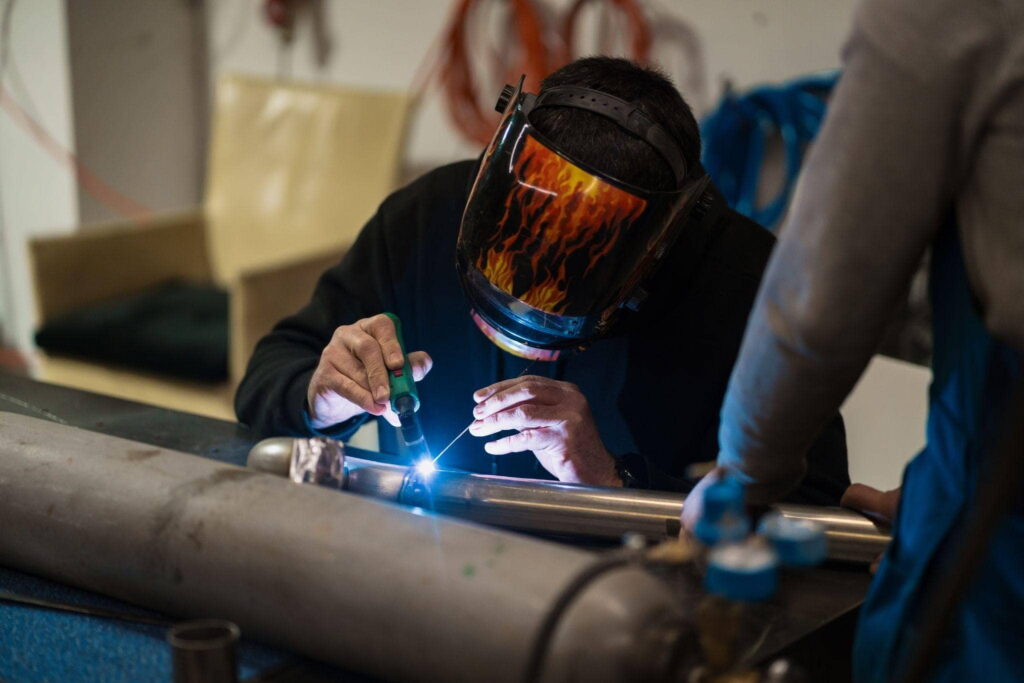
Known for precision, TIG welding is perfect for thin materials or jobs requiring clean, high-quality welds. It’s commonly used in the fabrication of stainless steel and aluminium.

Stick Welding (Shielded Metal Arc Welding)

A versatile, robust method often used outdoors or in industrial settings. In Melbourne, it’s especially helpful for heavy-duty welding and maintenance.

Every welding technique has its benefits, and our staff makes sure the appropriate approach is used for each metal production project.

Industries That Rely on Welding in Metal Fabrication

From small workshops to major construction sites, welding in Melbourne supports countless industries:

  • Construction: Structural steel frames, staircases, handrails
  • Automotive: Chassis fabrication, exhaust systems, custom components
  • Manufacturing: Machinery frames, brackets, fixtures
  • Retail & Hospitality: Custom benches, signage, decorative metalwork
  • Infrastructure: Pipes, gates, fencing, bridge components

Precision Tooling is proud to support businesses across these industries with reliable metal fabrication and welding in Melbourne.

What Sets Precision Tooling Apart?

Choosing the right fabrication partner is key to the success of your project. To produce excellent outcomes, Precision Tooling combines local knowledge, technology, and experience.

Certified Welders in Melbourne

Our skilled welders in Melbourne are trained in multiple techniques and adhere to Australian standards for safety and workmanship.

Full-Service Metal Fabrication

We oversee the entire process in-house, from design and development to welding, finishing, and delivery.

Custom Solutions

No two projects are the same. We collaborate closely with our customers to provide unique, reasonably priced fabrication solutions that precisely match their needs.

On-Time & On-Budget

We understand how critical timelines and budgets are. Our team is committed to delivering every job efficiently without compromising quality.

Looking for Professional Welding Services in Melbourne?

If you’re searching for dependable metal fabrication in Melbourne, Precision Tooling is your go-to partner. Whether it’s a one-off job or an ongoing industrial contract, we offer unmatched quality, expertise, and service.

From advanced welding techniques to complete structural assemblies, our team is equipped to handle projects of all sizes with professionalism and precision.